
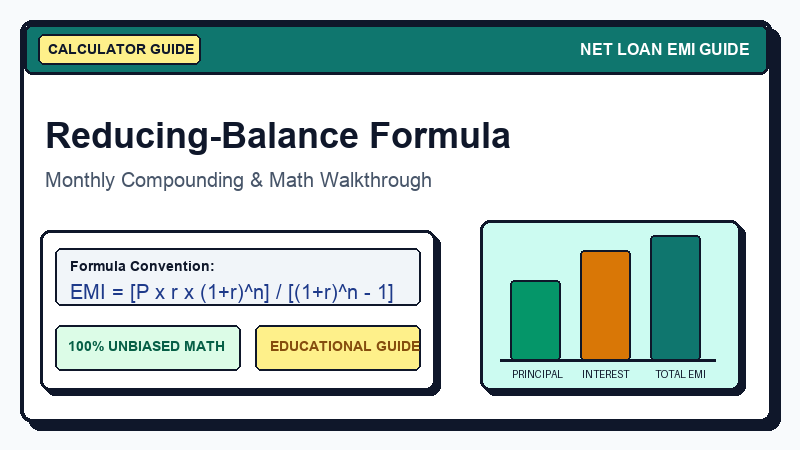
1. The Core Reducing-Balance EMI Formula
The standard benchmark methodology used by commercial banks, credit unions, and housing finance institutions worldwide for consumer loans (including mortgages, auto finance, and personal loans) is the Monthly Reducing-Balance (or Declining-Balance) Amortization Model.
Under this system, interest for each monthly billing cycle is assessed exclusively on the remaining outstanding principal rather than the original sanctioned loan amount. Each equal monthly installment (EMI) comprises two dynamic segments: an interest charge for the period and a principal curtailment that reduces the principal balance for the subsequent cycle.
Standard EMI Mathematical Equation:
EMI = P × r × (1 + r)^n ÷ ((1 + r)^n - 1)
Where:
• P = Principal Loan Amount (sanctioned net borrowing)
• r = Periodic Monthly Interest Rate (Annual Percentage Rate ÷ 12 ÷ 100)
• n = Loan Repayment Period in Total Monthly Cycles (Tenure in Years × 12)
2. Boundary Conditions & Edge Cases
Robust financial software must handle edge conditions without numerical instability or division-by-zero errors:
Zero-Percent Interest Rate (0% APR)
When promotional financing or interest-free installments are evaluated (where r = 0), applying the exponential reducing-balance equation directly yields 0 / 0, an indeterminate form. By L'Hôpital's rule, the mathematical limit as r → 0 simplifies to pure linear division:
EMI = P ÷ n
Our calculation engine automatically branches to this linear formula whenever the entered annual rate is zero, ensuring flawless instant computation.
Rounding and Terminal Cent Adjustments
Because currency calculations operate with two decimal places (cents / pence / paise), multiplying floating-point numbers across 120 to 360 monthly iterations can accumulate fractional penny discrepancies. In our amortization engine:
- Monthly interest for cycle m is calculated as:
Interest_m = Balance_(m-1) × r, rounded to 2 decimal places. - Principal repayment for cycle m is calculated as:
Principal_m = EMI - Interest_m. - For the final terminal month n, the remaining principal balance is adjusted exactly to ensure the final closing balance strictly terminates at
0.00.
3. Reducing-Balance vs. Flat-Rate Interest: The Cost Trap
A critical source of consumer misunderstanding in borrowing is the distinction between reducing-balance interest and flat-rate interest. While prime home loans virtually always use reducing balance, certain dealership car loans, microfinance lenders, or consumer electronics financing quote "flat" interest rates.
Flat Rate Equation:
Total Interest = P × (Annual Rate ÷ 100) × (n ÷ 12)
Total Payment = P + Total Interest
EMI = Total Payment ÷ n
In a flat-rate contract, you continue paying interest on the full original principal for the entire loan tenure, even when you have already repaid 90% of the principal! Consequently, a flat interest rate is nearly double the effective reducing-balance interest rate for typical loan terms.
| Loan Parameter ($10,000 for 3 Years) | Monthly Reducing-Balance (10%) | Flat-Rate Loan (10%) |
|---|---|---|
| Monthly EMI | $322.67 | $361.11 |
| Total Interest Paid | $1,616.19 | $3,000.00 |
| Total Amount Paid | $11,616.19 | $13,000.00 |
| Effective Reducing APR | 10.00% | 17.92% |
To preserve complete consumer transparency, Net Loan EMI Calculator provides a direct mode toggle on the homepage and calculator tools so users can contrast reducing balance against flat rate with a single click.
4. Upfront Fees and Effective Borrowing Cost (Net Disbursal)
Loan agreements often carry mandatory upfront administrative or processing fees, commonly ranging from 0.25% to 2.50% of the principal. These fees reduce the actual cash received in hand while the borrower remains obligated to repay the full principal plus interest:
Fee Amount = P × (Processing Fee % ÷ 100)
Net Disbursal Received = P - Fee Amount
Total Real Borrowing Cost = Total Interest + Fee Amount
Factoring in upfront fees raises the true Annual Percentage Rate (APR). Borrowers should always evaluate loan quotes on net disbursal rather than nominal headline interest rates.
5. Strict Client-Side Privacy Guarantee
Financial privacy is paramount. Unlike online tools that send loan inquiries to third-party brokers, lead aggregators, or remote tracking servers:
- 100% Client-Side Execution: All equations, slider adjustments, amortization tables, and chart renderings are executed entirely in your local browser runtime via vanilla JavaScript.
- Zero Data Transmission: No entered loan values, interest percentages, or tenure selections are ever transmitted across the internet, logged into databases, or shared with advertising platforms.
- Zero Third-Party Financial Telemetry: You can disconnect your internet connection entirely after loading the page, and the calculator will continue working offline with full mathematical functionality.