
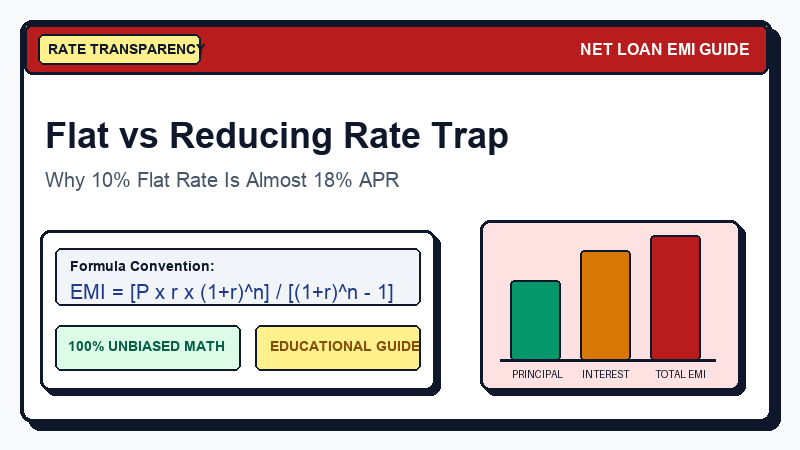
The Deceptive Allure of the "Flat" Interest Rate
When shopping for vehicle financing, retail installment plans, or personal loans, you may encounter lenders advertising remarkably low interest rates—such as "only 8% flat rate!" To an unsuspecting consumer, this sounds significantly cheaper than a bank offering a 12% reducing-balance personal loan.
In reality, a flat-rate loan is almost always substantially more expensive than a reducing-balance loan with a higher headline interest rate. Failing to recognize the difference is one of the most widespread and costly consumer finance mistakes.
How the Flat-Rate Calculation Works
Under a flat-rate contract, the lender computes interest on the entire original principal for the entire loan duration, completely ignoring the fact that you repay principal every month:
Total Flat Interest = P × (Flat Rate ÷ 100) × Tenure in Years
Total Repayment = P + Total Flat Interest
Monthly EMI = Total Repayment ÷ Total Months
If you borrow $10,000 for 3 years at a 10% flat rate:
• Total Interest = $10,000 × 0.10 × 3 = $3,000
• Total Repayment = $13,000
• Monthly EMI = $13,000 ÷ 36 = $361.11 per month
Comparing Side-by-Side: $10,000 for 3 Years
Now observe what happens when you compare this 10% flat rate against a 10% reducing-balance loan for the identical $10,000 loan over 36 months:
| Comparison Metric | 10% Flat Rate | 10% Reducing-Balance | Difference / Extra Cost |
|---|---|---|---|
| Monthly Installment | $361.11 | $322.67 | Flat costs $38.44/mo more |
| Total Interest Paid | $3,000.00 | $1,616.19 | Flat costs $1,383.81 extra! |
| Total Outflow | $13,000.00 | $11,616.19 | 85% more interest paid |
| Effective APR | 17.92% | 10.00% | Near double effective rate |
Why Does the Discrepancy Occur?
In a reducing-balance loan, as you make monthly payments, your outstanding balance steadily decreases from $10,000 to $0. On average over the 3-year term, your outstanding balance is roughly $5,000. Therefore, a 10% reducing rate charges interest on an average balance of $5,000.
In contrast, a flat rate charges interest on the full $10,000 for all 36 months! Even in Month 35, when you owe only $350, you are still being charged interest as if you held the entire $10,000.
Quick Rule-of-Thumb Conversion Formula
To convert a quoted flat interest rate into an approximate reducing-balance APR, use this practical financial rule of thumb:
Approximate Reducing APR ≈ Flat Rate × 1.85
Using this multiplier:
• An 8% flat rate ≈ 14.8% reducing APR
• A 10% flat rate ≈ 18.5% reducing APR
• A 12% flat rate ≈ 22.2% reducing APR
Always demand an official Key Facts Statement (KFS) or Annual Percentage Rate (APR) quote before signing any loan contract. You can test both calculation modes directly using the switcher on our Methodology & Math Page.