
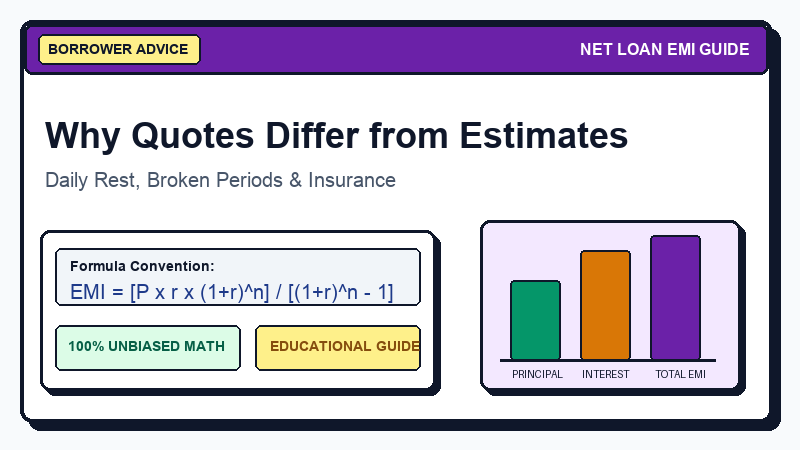
Why Does the Formal Bank Quote Differ from the Calculator?
You carefully researched your loan on an independent EMI calculator, entered the exact loan amount, interest rate, and tenure, and calculated an EMI of $1,250.00. Yet when your formal bank sanction letter or loan estimate arrives, the monthly installment is quoted as $1,268.40.
Why does this difference occur? Independent online calculators use standardized mathematical equations. While the math is rigorous, commercial lenders incorporate real-world operational parameters, day-count rules, and bundled fees that can create slight discrepancies.
Top 5 Reasons for Quotation Discrepancies
1. Pre-EMI / Broken-Period Interest
Standard online calculators assume your loan starts on the 1st of the month and your first payment occurs exactly 30 days later. In reality, loans are disbursed on random weekdays (e.g., the 17th of the month).
Lenders charge broken-period interest for the 13 days between disbursal (the 17th) and the commencement of the standard monthly cycle (the 1st). This interest may be deducted upfront or added to your initial monthly bill.
2. Day-Count Conventions (365 vs. 360 Days)
Most calculators assume 12 uniform months of 30.416 days. Institutional lending systems, however, often compute interest using specific day-count conventions:
- Actual/365: Daily interest is computed on exact calendar days (28 in February, 31 in March). Payments in 31-day months carry slightly higher interest than payments in 30-day months.
- 30/360: Assumes every month has 30 days regardless of calendar reality.
3. Mandatory Credit Life or Mortgage Insurance
Many lenders require or automatically bundle credit insurance (which pays off the loan in the event of disability or death) into the financing. If a $2,000 insurance premium is capitalized into your principal, your loan is now $102,000 rather than $100,000, raising your monthly EMI.
4. Rounding to the Nearest Dollar or Ten
While web calculators compute payments to the exact cent, some banking systems round monthly installments upward to the nearest whole dollar or ten dollars, reconciling the difference in the final maturity payment.
5. Advance EMI Requirements
In certain consumer installment agreements or auto loans, the lender requires payment in advance rather than in arrears (paying at the beginning of each month rather than at the end). An annuity due (advance payment) has slightly lower total interest than payment in arrears, though total cash timing differs.
How to Reconcile the Discrepancy
When you spot a discrepancy between your calculation and the lender's quote, ask the loan officer for a copy of the amortization breakdown and fee disclosure. Ask specifically: "Are any insurance premiums, administrative surcharges, or broken-period interest charges bundled into this installment?"
To inspect the underlying formulas used on our site, review our Math & Methodology Page.