
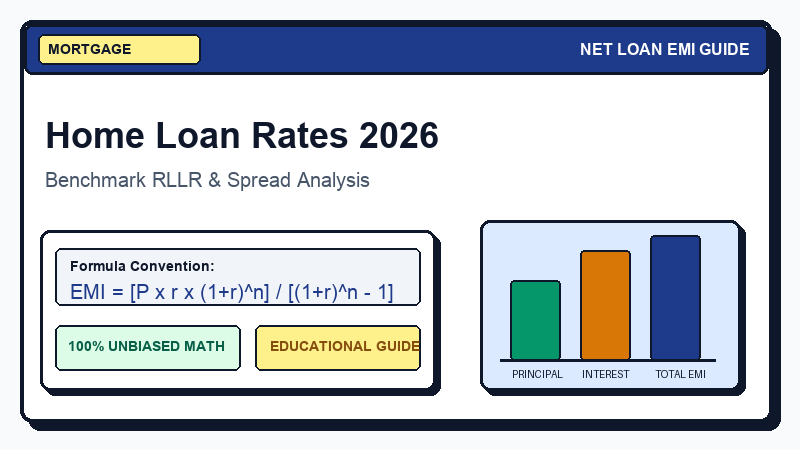
Current Home Loan Interest Rates in India
Finding the best home loan interest rate is crucial for anyone looking to purchase a property in 2026. With multiple banks and financial institutions competing for borrowers, the home loan market offers varied interest rates that can significantly impact your monthly EMI and total interest outgo over the loan tenure.
The home loan interest rate landscape in India has seen considerable movement in recent years due to RBI policy changes and market dynamics. As of early 2026, home loan interest rates from major banks range between 8.25% to 9.50% per annum, depending on various factors including the borrower's credit profile, loan amount, and the type of interest rate chosen.
Understanding these rates and comparing them effectively can help you save lakhs of rupees over your loan tenure. This comprehensive guide covers the latest interest rates from all major lenders, factors affecting your rate, and strategies to secure the best possible deal for your home loan.
Important Update
Interest rates are subject to change based on RBI monetary policy decisions. The rates mentioned here are indicative and were last updated in February 2026. Always verify current rates directly with the lender before applying.
Home Loan Interest Rates from Major Banks (2026)
Below is a comprehensive comparison of home loan interest rates offered by leading public sector banks, private banks, and housing finance companies in India.
Public Sector Banks
| Bank Name | Interest Rate | Processing Fee | Max Tenure |
|---|---|---|---|
| State Bank of India (SBI) | 8.25% - 9.15% | 0.35% + GST | 30 years |
| Bank of Baroda | 8.30% - 9.20% | 0.25% - 0.50% | 30 years |
| Punjab National Bank | 8.35% - 9.25% | 0.35% + GST | 30 years |
| Canara Bank | 8.30% - 9.15% | 0.50% (Max Rs.10,000) | 30 years |
| Union Bank of India | 8.35% - 9.30% | 0.50% + GST | 30 years |
| Bank of India | 8.30% - 9.20% | 0.25% + GST | 30 years |
Private Sector Banks
| Bank Name | Interest Rate | Processing Fee | Max Tenure |
|---|---|---|---|
| HDFC Bank | 8.35% - 9.25% | 0.50% or Rs.3,000 | 30 years |
| ICICI Bank | 8.35% - 9.20% | 0.50% - 1.00% | 30 years |
| Axis Bank | 8.40% - 9.30% | Up to 1% | 30 years |
| Kotak Mahindra Bank | 8.45% - 9.35% | 0.50% | 25 years |
| Yes Bank | 8.55% - 9.45% | Up to 1.5% | 25 years |
| IndusInd Bank | 8.50% - 9.40% | 0.50% - 1% | 25 years |
Housing Finance Companies (HFCs)
| Company Name | Interest Rate | Processing Fee | Max Tenure |
|---|---|---|---|
| LIC Housing Finance | 8.35% - 9.20% | 0.50% + GST | 30 years |
| HDFC Ltd | 8.35% - 9.15% | 0.50% or Rs.3,000 | 30 years |
| PNB Housing Finance | 8.50% - 9.40% | Up to 0.50% | 30 years |
| Tata Capital Housing | 8.60% - 9.50% | Up to 0.50% | 30 years |
| Bajaj Housing Finance | 8.45% - 9.30% | Up to 0.50% | 30 years |
| Indiabulls Housing | 8.65% - 9.55% | Up to 1% | 25 years |
Factors Affecting Your Home Loan Interest Rate
The interest rate you receive on your home loan is not uniform for all borrowers. Lenders consider multiple factors to determine the rate applicable to your loan. Understanding these factors can help you position yourself better for a lower rate.
1. Credit Score (CIBIL Score)
Your credit score is one of the most important factors determining your home loan interest rate. Borrowers with higher credit scores are considered lower risk and typically receive better interest rates. Most banks offer the best rates to borrowers with CIBIL scores above 750.
- 750-900: Best rates, highest chances of approval
- 700-749: Good rates, high approval probability
- 650-699: Moderate rates, may need additional documentation
- Below 650: Higher rates, may face difficulty in approval
2. Loan Amount and LTV Ratio
The loan amount and Loan-to-Value (LTV) ratio impact your interest rate. Higher LTV ratios (lower down payment) may attract slightly higher interest rates. Similarly, very high loan amounts might receive preferential rates from some lenders targeting premium customers.
3. Employment Type and Income
Salaried employees, especially those working for reputed companies, government organizations, or MNCs, often receive lower interest rates compared to self-employed individuals. Your income stability and monthly income level also influence the rate offered.
4. Property Type and Location
The type of property (under-construction vs. ready-to-move) and its location can affect your interest rate. Properties in tier-1 cities from reputed builders may receive better rates compared to properties in tier-2 or tier-3 cities.
5. Relationship with the Bank
Existing customers with salary accounts, fixed deposits, or other banking relationships often receive preferential rates. Some banks offer rate discounts of 0.10% to 0.25% for existing customers with good track records.
How to Get the Lowest Home Loan Interest Rate
Securing the lowest possible interest rate requires preparation and smart negotiation. Here are proven strategies to help you get the best deal.
Improve Your Credit Score
Before applying for a home loan, check your credit report and work on improving your score. Pay off existing debts, ensure timely payment of all bills, and avoid applying for multiple loans or credit cards simultaneously. A score above 750 significantly improves your negotiating position.
Make a Higher Down Payment
Offering to pay a higher down payment (25-30% instead of the minimum 10-20%) reduces the lender's risk and can help you negotiate a lower interest rate. It also reduces your loan amount and subsequently your EMI burden.
Compare Multiple Lenders
Never accept the first offer you receive. Get quotes from at least 4-5 different lenders including both banks and housing finance companies. Use these quotes to negotiate with your preferred lender.
Negotiate Processing Fees
While interest rates are crucial, don't ignore processing fees. These can add Rs. 15,000 to Rs. 50,000 to your loan cost. Many lenders are willing to reduce or waive processing fees, especially during festive seasons or for premium customers.
Consider Balance Transfer Later
If you cannot get the best rate initially, remember that you can always transfer your loan to another lender offering better rates after 1-2 years. This flexibility allows you to start your homeownership journey now and optimize later.
Fixed vs Floating Interest Rates
When taking a home loan, you need to choose between fixed and floating interest rates. Each has its advantages and situations where it makes more sense.
Floating Rate Home Loans
Floating rates are linked to the bank's benchmark rate (often the Repo Rate or MCLR) and change when the benchmark changes. Most home loans in India are floating rate loans because:
- Initial rates are typically 0.5% to 1% lower than fixed rates
- You benefit when interest rates fall
- No prepayment penalties on floating rate loans
- More flexibility in loan terms
Fixed Rate Home Loans
Fixed rates remain constant for a specified period (usually 2-5 years or the entire tenure). Consider fixed rates when:
- Interest rates are expected to rise significantly
- You want predictable EMIs for budgeting
- You can afford the slightly higher initial rate
- You don't plan to prepay the loan significantly
Special Home Loan Schemes in 2026
Several banks offer special schemes with reduced interest rates for specific categories of borrowers or properties.
Women Borrowers Concession
Most banks offer 0.05% to 0.10% interest rate concession when a woman is the sole or first applicant. If your spouse has better eligibility, consider making the wife the primary borrower to avail this benefit.
Green Home Loans
For homes with green building certifications (IGBC, GRIHA, etc.), some banks offer reduced rates of 0.10% to 0.25%. This incentive promotes environmentally sustainable construction.
Government Employee Schemes
Government employees, defense personnel, and PSU employees often qualify for special schemes with lower rates and reduced documentation requirements.
Pradhan Mantri Awas Yojana (PMAY)
Eligible borrowers can receive interest subsidy of up to Rs. 2.67 lakhs under PMAY Credit Linked Subsidy Scheme (CLSS). Check your eligibility based on income category and property value.
Frequently Asked Questions
As of early 2026, State Bank of India (SBI) offers one of the lowest home loan interest rates starting from 8.25% for eligible borrowers. However, rates vary based on loan amount, tenure, and borrower profile. LIC Housing Finance and Bank of Baroda also offer competitive rates. Always compare offers from multiple lenders based on your specific eligibility.
Home loan interest rates are influenced by RBI's monetary policy, inflation levels, and economic conditions. If the RBI continues its accommodative stance and reduces the Repo rate, home loan rates may decrease. However, rate movements are difficult to predict accurately. Taking a floating rate loan allows you to benefit automatically when rates fall.
You can reduce your existing home loan interest rate by: (1) Requesting your current lender for a rate revision citing competitive offers; (2) Transferring your loan to another lender offering lower rates (balance transfer); (3) Making partial prepayments to reduce the outstanding principal; or (4) Converting from fixed to floating rate if applicable and beneficial.
RLLR (Repo Linked Lending Rate) based loans are directly linked to RBI's Repo rate and change immediately when the Repo rate changes. MCLR (Marginal Cost of Funds based Lending Rate) is the bank's internal benchmark that changes based on the bank's cost of funds. RLLR loans offer more transparent and faster transmission of rate changes to borrowers.
Having a salary account with the lender can offer benefits like faster processing, reduced documentation, and sometimes preferential interest rates. However, don't limit yourself to just one option. Compare offers from multiple lenders and use your relationship bank's offer as a negotiating tool with other lenders offering better rates.
Conclusion
Choosing the right home loan interest rate can save you lakhs of rupees over your loan tenure. In 2026, with rates ranging from 8.25% to 9.50%, there's significant variation among lenders that you can leverage to your advantage.
Focus on improving your credit score, comparing offers from multiple lenders, and negotiating effectively. Don't forget to consider factors beyond just the interest rate, such as processing fees, customer service quality, and the lender's flexibility with prepayments.
Use our Home Loan EMI Calculator to see how different interest rates affect your monthly EMI and total interest payable. This will help you make an informed decision that aligns with your financial goals.