
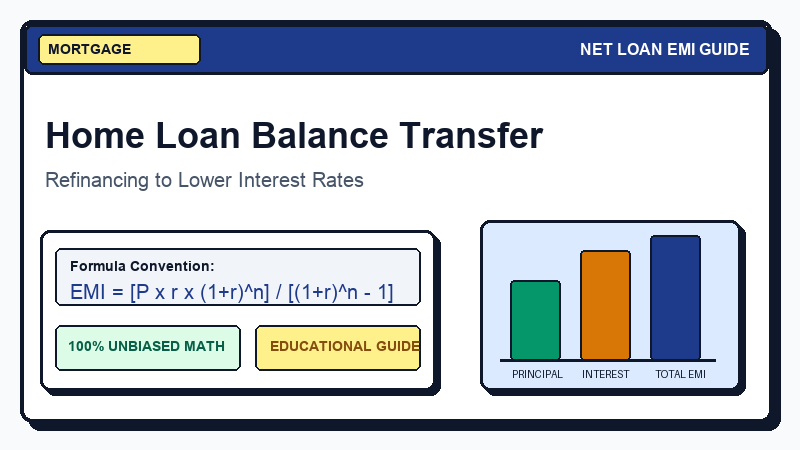
What is Home Loan Balance Transfer?
Home loan balance transfer is the process of moving your existing home loan from one lender to another, typically to take advantage of lower interest rates. When you transfer, the new lender pays off your outstanding loan with the current lender, and you begin paying EMIs to the new lender at their interest rate.
This can result in significant savings, especially if interest rates have dropped since you took your original loan or if your credit score has improved, making you eligible for better rates.
When Should You Consider Balance Transfer?
Good Reasons to Transfer
- Interest rate difference of 0.5% or more: Lower rate means substantial savings over loan tenure
- Remaining tenure of 10+ years: More time to recover transfer costs and benefit from lower rate
- Good repayment track record: Makes you attractive to other lenders
- Improved credit score: May qualify for rates you didn't get originally
- Poor service from current lender: Better customer service can add value
When NOT to Transfer
- Rate difference is less than 0.25%
- Less than 5 years remaining on loan
- Fixed rate loan with high foreclosure charges
- Already in late stages of loan (most interest already paid)
- Planning to prepay/foreclose soon
How Much Can You Save?
| Outstanding Loan | Rate Reduction | Remaining Tenure | Interest Saved |
|---|---|---|---|
| Rs. 40 Lakhs | 0.5% | 15 years | Rs. 4.5 Lakhs |
| Rs. 40 Lakhs | 1.0% | 15 years | Rs. 8.8 Lakhs |
| Rs. 60 Lakhs | 0.5% | 20 years | Rs. 8.2 Lakhs |
| Rs. 60 Lakhs | 1.0% | 20 years | Rs. 15.9 Lakhs |
Calculate Your Savings
Use our EMI Calculator to compare your current EMI with the new EMI at the transferred rate. Multiply the difference by remaining months to estimate your savings.
Costs Involved in Balance Transfer
Balance transfer isn't free. You need to factor in these costs when deciding:
| Cost Component | Typical Amount | Paid To |
|---|---|---|
| Processing Fee | 0.5% - 1% of loan amount | New Lender |
| Legal & Technical Fee | Rs. 5,000 - 15,000 | New Lender |
| Stamp Duty | Varies by state (0.1% - 0.5%) | Government |
| Foreclosure Charges | Nil for floating rate loans | Old Lender |
| Documentation Charges | Rs. 1,000 - 5,000 | Both Lenders |
Rule of Thumb: Your total transfer costs should be recoverable within 18-24 months of savings from the lower rate. If recovery takes longer, reconsider the transfer.
Step-by-Step Balance Transfer Process
- Compare offers from multiple lenders: Get rate quotes from at least 3-4 banks
- Apply to new lender: Submit application with required documents
- Get sanction letter: New lender evaluates and issues sanction with terms
- Request NOC from current lender: Inform old lender about your intent to transfer
- Property verification: New lender conducts legal and technical verification
- Loan disbursement: New lender pays off the old loan directly
- Document transfer: Property documents moved from old to new lender
- Start new EMI: Begin payments to new lender
Documents Required for Balance Transfer
From Current Lender
- Loan account statement showing outstanding balance
- List of EMIs paid with dates
- No Objection Certificate (NOC) or consent letter
- Foreclosure letter stating payoff amount
- Original property documents (after foreclosure)
For New Lender
- KYC documents (PAN, Aadhaar, address proof)
- Income proof (salary slips, ITR, bank statements)
- Property documents copies
- Loan account statement from current lender
- Last 12-24 months EMI payment proof
Top-Up Loan with Balance Transfer
Many borrowers combine balance transfer with a top-up loan to meet additional financial needs. This can be efficient as:
- You can borrow additional amount at home loan rates (lower than personal loan)
- Single application process for transfer and top-up
- Combined processing fee may be lower than separate applications
- Top-up amount based on current property value minus outstanding loan
Tips for Successful Balance Transfer
- Negotiate processing fee: Many lenders waive or reduce fees to acquire new customers
- Check for hidden charges: Read the fine print for all applicable fees
- Time it right: Apply when rates are low and before year-end when banks push for targets
- Maintain clean repayment: Don't miss EMIs before or during transfer process
- Get everything in writing: Ensure the promised rate is in the sanction letter
- Compare effective rate: Consider processing fee impact on effective interest rate
Frequently Asked Questions
The typical timeline is 2-4 weeks, though it can vary. Major steps include application processing (3-5 days), property verification (5-7 days), NOC from old lender (7-10 days), and final disbursement (2-3 days). Having all documents ready speeds up the process.
Yes, there's no limit on how many times you can transfer your home loan. However, each transfer incurs costs and impacts your credit inquiry score. It makes sense only if the rate difference justifies the costs. Most people transfer once or twice during their loan tenure.
There's a minor temporary impact from the credit inquiry by the new lender. However, if you continue paying EMIs on time with the new lender, your score will recover and may even improve due to lower credit utilization if you don't increase your overall debt.
Yes, you can negotiate a new tenure with the new lender. You can extend tenure to reduce EMI or reduce tenure if you want to pay off faster. The new lender will determine maximum tenure based on your age and their policies.
Lenders cannot unreasonably refuse to issue NOC for floating rate loans (as per RBI guidelines). If you face resistance, escalate to the bank's grievance cell and mention that you'll approach the Banking Ombudsman. Most issues get resolved with escalation.
Conclusion
Home loan balance transfer is a powerful tool to reduce your interest burden, but it needs careful evaluation. Consider the costs, remaining tenure, and rate difference before deciding. A well-timed balance transfer can save you several lakhs over your loan tenure.
Use our Home Loan EMI Calculator to compare your current and potential new EMI. Calculate the total savings and weigh them against transfer costs to make an informed decision.