
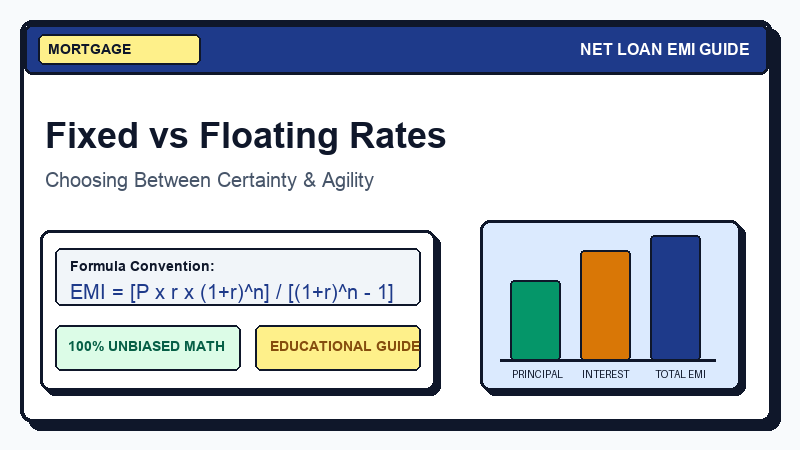
Understanding Fixed and Floating Interest Rates
When you apply for a home loan, one of the most important decisions you will face is choosing between a fixed and floating interest rate. This choice significantly impacts your monthly EMI payments and the total interest you pay over the loan tenure. Making the right decision requires understanding how each type works and evaluating your financial situation and market outlook.
Both fixed and floating rate home loans have their advantages and drawbacks. The right choice depends on factors like your risk tolerance, income stability, market conditions, and how long you plan to hold the loan. This comprehensive guide will help you understand the differences and make an informed decision.
What is a Fixed Interest Rate Home Loan?
A fixed interest rate home loan has an interest rate that remains constant throughout a specified period or the entire loan tenure. This means your EMI amount stays the same regardless of changes in market interest rates, RBI policy decisions, or bank lending rate revisions.
How Fixed Rates Work
When you take a fixed rate home loan, the bank locks in the interest rate at the time of loan disbursement. This rate typically remains unchanged for either:
- A specific initial period (2-5 years) after which it converts to floating rate
- The entire loan tenure (though this is less common in India)
Fixed rates are usually 1% to 2% higher than floating rates to compensate lenders for the risk of rate movements. This premium is essentially the cost of certainty and predictability.
Advantages of Fixed Rate Home Loans
- Predictable EMIs: Your monthly payment remains constant, making budgeting easier
- Protection from rate hikes: If market rates increase, your rate stays the same
- Peace of mind: No need to monitor interest rate movements
- Easier financial planning: Know exactly what you'll pay over the loan tenure
Disadvantages of Fixed Rate Home Loans
- Higher initial rate: Usually 1-2% more than floating rates
- Miss rate cuts: You don't benefit when market rates decrease
- Prepayment penalties: May have charges for early repayment
- Limited availability: Fewer banks offer true fixed rate products
- Higher overall cost: Due to higher rate, total interest paid is more
What is a Floating Interest Rate Home Loan?
A floating interest rate home loan has an interest rate that changes based on market conditions and the bank's benchmark lending rate. In India, floating rates are typically linked to the Repo Linked Lending Rate (RLLR) or Marginal Cost of Funds based Lending Rate (MCLR).
How Floating Rates Work
The floating rate is expressed as: Benchmark Rate + Spread/Margin
For example, if RLLR is 6.25% and the spread is 2%, your interest rate would be 8.25%. When the benchmark changes, your rate adjusts accordingly while the spread remains constant throughout the loan tenure.
Understanding RLLR vs MCLR
Since October 2019, RBI mandated that all new floating rate loans must be linked to external benchmarks like Repo Rate. RLLR-linked loans offer faster transmission of rate changes compared to older MCLR-linked loans. If you have an MCLR-linked loan, consider switching to RLLR for better rate transmission.
Advantages of Floating Rate Home Loans
- Lower initial rate: 1-2% lower than fixed rates
- Benefit from rate cuts: Your EMI decreases when market rates fall
- No prepayment penalties: For individual borrowers on floating rates
- Wide availability: All banks offer floating rate products
- Lower total cost: Over long tenures, usually cheaper than fixed
Disadvantages of Floating Rate Home Loans
- EMI uncertainty: Monthly payment can increase or decrease
- Exposure to rate hikes: Your EMI increases when rates rise
- Budgeting challenges: Difficult to plan for variable payments
- Requires monitoring: Need to track rate movements
Detailed Comparison: Fixed vs Floating Rates
| Parameter | Fixed Rate | Floating Rate |
|---|---|---|
| Initial Interest Rate | Higher (8.5% - 10%) | Lower (8.25% - 9%) |
| EMI Stability | Constant | Variable |
| Rate Transmission | None during fixed period | Immediate (RLLR) or Quarterly (MCLR) |
| Prepayment Penalty | Usually 2-3% | None for individuals |
| Risk Profile | Lower risk | Higher risk |
| Best When | Rates expected to rise | Rates expected to fall/stable |
| Total Interest Cost | Usually higher | Usually lower |
When Should You Choose Fixed Rate?
A fixed interest rate might be the better choice in the following situations:
1. Rising Interest Rate Environment
If economic indicators suggest that interest rates are likely to increase in the near future, locking in a fixed rate protects you from future hikes. Monitor RBI statements, inflation trends, and economic forecasts to gauge rate direction.
2. Tight Monthly Budget
If your EMI represents a significant portion of your income (close to the 40-50% threshold), fixed rates provide safety. An unexpected EMI increase on a floating rate loan could strain your finances.
3. Short to Medium Tenure
For loans with tenures of 5-10 years, the impact of rate differences is less pronounced. Fixed rates offer stability without significantly higher total cost over shorter periods.
4. Risk-Averse Personality
If market volatility causes you stress, fixed rates provide peace of mind. The certainty of knowing exactly what you'll pay each month has psychological value.
When Should You Choose Floating Rate?
A floating interest rate is generally better in these scenarios:
1. Falling or Stable Rate Environment
When rates are high or expected to decrease, floating rates allow you to benefit from future cuts. India has seen multiple rate cut cycles, making floating rates advantageous.
2. Long Loan Tenure
For 20-30 year loans, the lower initial rate of floating loans can save substantial amounts. Over long periods, rates typically cycle through highs and lows, averaging out.
3. Plan to Prepay
If you expect windfalls (bonuses, inheritance, property sale) that you'll use for prepayment, floating rates are better as there are no prepayment penalties for individual borrowers.
4. Financial Buffer Available
If you have emergency funds and your EMI is well within your comfortable range, you can absorb potential EMI increases without financial stress.
Hybrid Option: Combination Loans
Some banks offer combination or hybrid loans that combine features of both fixed and floating rates. These typically start with a fixed rate for 2-5 years and then convert to floating rate for the remaining tenure.
Benefits of Hybrid Loans
- Initial stability during early years when income might be lower
- Lower fixed rate compared to full-tenure fixed loans
- Flexibility of floating rates in later years
- Good for borrowers expecting income growth
Cost Comparison Example
Let's compare the total cost of a Rs. 50 lakh loan for 20 years under different scenarios:
| Scenario | Interest Rate | Monthly EMI | Total Interest |
|---|---|---|---|
| Fixed Rate | 9.5% throughout | Rs. 46,607 | Rs. 61.86 Lakhs |
| Floating (Stable) | 8.5% throughout | Rs. 43,415 | Rs. 54.20 Lakhs |
| Floating (Rates Rise) | 8.5% ? 10% in Y5 | Rs. 43,415 ? Rs. 48,306 | Rs. 58.50 Lakhs |
| Floating (Rates Fall) | 8.5% ? 7.5% in Y3 | Rs. 43,415 ? Rs. 40,562 | Rs. 49.80 Lakhs |
Tips for Making Your Decision
- Assess your risk tolerance: How would you feel if your EMI increased by Rs. 5,000?
- Check economic outlook: Research interest rate forecasts and RBI policy direction
- Calculate both scenarios: Use our EMI calculator to compare costs
- Consider your income trajectory: Expected raises can offset rate increases
- Evaluate prepayment plans: Floating rates are better if you'll prepay
- Read the fine print: Understand reset clauses, conversion options, and penalties
Frequently Asked Questions
Yes, most banks allow conversion from fixed to floating rate, usually after the initial fixed period ends. Some may charge a conversion fee (typically 0.5% to 1% of outstanding principal). Contact your lender to understand the specific terms and process for conversion.
For RLLR-linked loans, the change is transmitted immediately or at the next reset date (usually monthly or quarterly). If RBI cuts Repo Rate by 0.25%, your home loan rate will also decrease by 0.25%, reducing your EMI proportionally. The same applies when rates increase.
Banks charge a premium for fixed rates because they bear the interest rate risk. If market rates increase, they still have to lend to you at the lower fixed rate, potentially losing money. The premium compensates for this risk and the opportunity cost of locking in funds at a fixed rate.
In India, most "fixed rate" loans are fixed only for an initial period (2-5 years) and then reset to floating rates. True full-tenure fixed rate loans are rare. Always read the loan agreement carefully to understand when and how the rate might change.
For most first-time homebuyers, floating rate loans are generally recommended because of lower initial rates and no prepayment penalties. However, if you're on a tight budget and need EMI certainty, consider a hybrid loan that offers fixed rates initially and converts to floating after 3-5 years.
Conclusion
The choice between fixed and floating interest rates is not one-size-fits-all. While floating rates have historically been more economical for most borrowers in India, fixed rates offer valuable certainty that some borrowers need.
Evaluate your personal financial situation, risk tolerance, and market outlook before deciding. Remember that you can always refinance or convert your loan type later if circumstances change. Use our Home Loan EMI Calculator to model different scenarios and see how rate changes would affect your payments.